
What is AI readiness (in the context of search)?
There is ever growing buzz about being ‘AI ready’, but, practically speaking, what does that mean? And what actions should you be taking?

Search is evolving. Traditional search engines are increasingly incorporating AI into how they discover, interpret and present information, while platforms such as ChatGPT, Claude, Perplexity, Gemini (and others) are changing how people find answers, research products and make decisions.
For businesses, this creates a new challenge: it's no longer just about being visible in traditional search results (SEO). It's about ensuring your website, content, brand and data are accessible, understandable and useful to AI-powered search systems (GEO - generative engine optimisation).
This is where AI readiness comes in.
AI readiness is about assessing how well-equipped your business is for this changing search landscape. It considers everything from whether AI systems can access your website to how effectively they understand your products, services, expertise and brand.
It's not a replacement for traditional SEO. Rather, it builds on many of the same foundations while addressing the additional requirements of AI-powered search and agentic experiences.
At a glance:
- The six pillars for AI readiness:
- Accessibility
- Understandability
- Content quality
- Authority and trust
- Data interoperability
- Measurement
- AI readiness example audit - yes, that's right, we’re providing you with an example audit to put some meat on the bones.
- AI readiness audit tools - a free tool you can run now to assess how AI ready your website is for search.
Note: the following post has been largely aimed at ecommerce websites. The fundamentals, however, broadly relate to all websites.
The six pillars of AI readiness
1. Accessibility and discoverability
With accessibility and discoverability, we are talking specifically about bots and their ability to access a website, crawl and index.
Bots used by AI platforms come in two forms:
- Dedicated crawlers to retrieve website content
- Browser-based agents to navigate and interact with websites (an agent that can use a browser and navigate in the same manner a human user would).
It’s worth noting that search engines also rely on bots to discover pages and index content (e.g. Google has Googlebot), but each AI platform has its own crawler (with varying capabilities) and its own user agent.
By way of example, many AI bots do not render JavaScript. In comparison, Googlebot does render JavaScript. What does this mean? For sites that are heavily reliant upon JavaScript / client-side rendering, content is not accessible to the AI bots that do not render JavaScript. If the content can’t be ‘seen’ it can’t be cited.
In short, just because your website performs well in traditional search, it could still have AI accessibility / discoverability issues.
Here is what to check for site / page access:
| # | Check | What to look for |
|---|---|---|
| 1 | Robots.txt | Are GPTBot, OAI-SearchBot, ClaudeBot, PerplexityBot, Google-Extended, etc. blocked? Are important directories accidentally disallowed? |
| 2 | WAF / CDN / bot protection | Does Cloudflare, Akamai, Vercel, etc. distinguish AI crawlers from normal users? Are AI agents being challenged or blocked? |
| 3 | Authentication and consent | Is important content hidden behind login, cookies, consent walls or other barriers? |
What to check for content-specific accessibility:
| # | Check | What to look for |
|---|---|---|
| 1 | JavaScript | Are pages or specific components reliant upon JavaScript to render? |
What to check for discoverability:
| # | Check | What to look for |
|---|---|---|
| 1 | XML sitemaps | Are important pages included? Are sitemap URLs canonical, indexable and returning 200 responses? |
| 2 | Internal linking | Can an AI crawler navigate from the homepage, category pages and other key pages to important content? |
| 3 | Orphan pages | Are commercially important pages only discoverable through search, filters or JavaScript? |
| 4 | Redirects | Are there redirect chains or loops that make crawling unnecessarily difficult? |
What to check to ensure that browser-based bots can use your website:
| # | Check | What to look for |
|---|---|---|
| 1 | Key actions | Can an agent identify a product, select a variant and add it to the cart? |
| 2 | Forms | Are forms properly labelled and programmatically understandable? |
| 3 | Buttons and links | Do they have meaningful text, or are there lots of divs, icons and JavaScript click handlers that make actions difficult to interpret? |
| 4 | Product / category filtering | Can an agent understand available filters and the resulting URLs? |
| 5 | Checkout / conversion paths | Can an agent progress through the key user journey without encountering unnecessary barriers? |
2. Understandability and structure
Once an AI system can reach a page, the next question is whether it can reliably understand what the page contains. Clear content, semantic structure and supporting metadata can all help.
What to check for understandability:
| # | Check | What to look for |
|---|---|---|
| 1 | Semantic HTML | Are headings, lists, tables, links, buttons and other elements represented appropriately? Clear structure can make information easier for AI to interpret. |
| 2 | Structured data | Is relevant schema such as Product, Article, Organization, LocalBusiness, FAQPage and BreadcrumbList present, accurate and consistent with the visible page? |
| 3 | Page titles and descriptions | Does the page clearly identify what it is about? |
| 4 | Entity information | Can an AI easily establish who you are, what you sell/do, where you operate and why you're credible? |
| 5 | Consistent information | Is key business information consistent across your website and other digital properties? |
The objective is to reduce ambiguity and make it easier for AI systems to establish what your business represents and what information it can provide.
3. Content and information quality
AI search is typically much more detailed and nuanced than traditional search engine search.
Where a ‘normal’ search in a search engine might be ‘blue 2 seater sofa’, a ‘normal’ search on an AI platform might be: “I’m looking for a blue 2 seater sofa - I’m not entirely sure on the fabric but ideally it's easy to clean (perhaps removable covers?) as I’ve got 2 dogs - what would you recommend?”
Unsurprisingly, an AI platform will make many searches looking for those specific features and cite products where it has been able to determine (via the content or a reasonable leap of faith) that the product meets the criteria. See screen grab below:
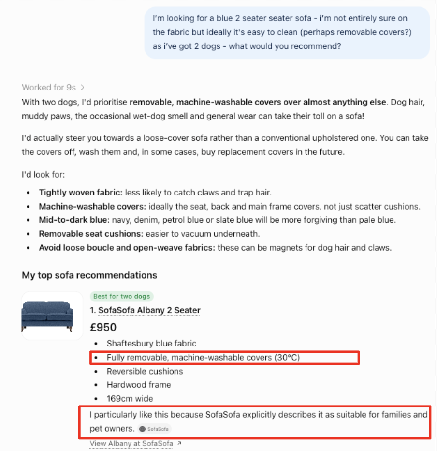
The key consideration for content and information is thus being detailed and answering users' questions.
Key considerations for content auditing:
| # | Check | What to look for |
|---|---|---|
| 1 | Answerability | Does your content clearly answer the questions your audience is asking (or likely to be asking)? |
| 2 | Information clarity | Is information presented in a clear, logical and easily interpretable format? |
| 3 | Targeting specific personas / users | Specifically relating to product descriptions, does the content say who the product is suitable for? |
| 4 | Content accuracy | Is information accurate and up to date (for example product features, imagery, stock levels, etc.)? |
4. Authority and trust
AI systems have been built to mimic users in the research phase; users want to make sure they are purchasing from a credible store. They look for reviews, third-party references on publications and forums, and social channels. AI systems do the same.
Brand authority, reputation and trust are therefore important considerations when assessing AI readiness.
For example, a business might have a well-optimised website but limited third-party recognition, inconsistent brand information or very little independent discussion about its products and services (thus reducing confidence in purchasing).
Areas to consider include:
| # | Check | What to look for |
|---|---|---|
| 1 | Brand mentions | Is your brand referenced across relevant, reputable websites and publications? |
| 2 | Third-party recognition | Are your products, services and expertise discussed independently? |
| 3 | Reviews and reputation | Are there credible customer reviews, ratings and testimonials? |
| 4 | Author expertise | Is the experience and knowledge behind your content clearly attributed? |
| 5 | Entity consistency | Is your brand consistently represented across websites, directories and other digital platforms? |
| 6 | Supporting evidence | Are claims and statements supported by reliable information? |
5. Data and agent interoperability
One of the more significant developments in search is the emergence of AI agents that can do more than retrieve and summarise information.
As these experiences develop, AI systems are increasingly expected to interact with websites, access structured business information and potentially complete tasks on behalf of users.
This introduces another dimension to AI readiness: can AI systems actually use your business information and interact with your digital infrastructure?
For ecommerce businesses, this might involve accessing accurate product information, pricing, availability and delivery details.
For service-based businesses, it could mean making information about services, availability and booking processes easier for AI agents to access.
Considerations include:
| # | Check | What to look for |
|---|---|---|
| 1 | Product feeds | Is product information available through structured, accessible feeds? |
| 2 | APIs and integrations | Can relevant business information be accessed programmatically? |
| 3 | Data consistency | Are pricing, stock levels, product attributes and other important details accurate across different platforms? |
| 4 | Transactional accessibility | Can agents navigate forms, booking processes and other important interactions? |
| 5 | Machine-readable information | Is business data available in formats that systems can reliably consume? |
A lot of this infrastructure is making way for AI commerce, in which products can be researched and transacted all within the AI platform (meaning there is no need for the user to go to the seller's website and transact there).
If you’ve been observing Shopify’s updates to infrastructure and AI channels, you’ve likely come across a lot of these considerations before. And if you're already on Shopify, that's good news.
Note - not every business needs to build an agent-ready transactional infrastructure today. However, understanding the opportunities and limitations is an important part of preparing for the direction search is heading.
6. Measurement and optimisation
To be transparent, measurement is one area which is still being muddled through as an industry.
In traditional search, the norm has been to track keywords in Google, recording keyword ranking positions, visibility (and other metrics) as well as observing organic traffic in analytics.
For AI, the principle is broadly the same, but there is some complication because:
- There is no ‘real’ prompt data as of yet - it's all synthetic / AI generated.
- The number of prompts is a huge multiple in comparison to keywords (making it impossible to track them all).
- There are a large number of AI platforms where users are searching; think ChatGPT, Gemini, Claude, Perplexity (to name but a few).
- Users do not necessarily need to leave the AI platforms; research and transaction are all possible within these applications (although the agent will make searches, view pages, etc. for a user).
- Citations vs mentions - often a site will be referenced without a link, meaning a user arrives via a different channel (i.e. Google or direct), so first-click attribution is incorrect.
- It's challenging to say what ‘good’ looks like for AI referral traffic as many users are adopting AI platforms (meaning you’d expect AI referral traffic to grow to some degree just from AI adoption, as opposed to improvements in GEO).
With these caveats in place, the current consensus for measuring is:
| # | Measure | What to look for |
|---|---|---|
| 1 | AI search visibility | How frequently does your brand appear in AI-generated answers and recommendations? |
| 2 | Brand mentions and citations | Is your business being referenced as a source of information? |
| 3 | Prompt coverage | Are you appearing for the questions and topics that matter to your audience? |
| 4 | Competitor visibility | How does your brand compare with competitors across AI search experiences? |
| 5 | Referral traffic | Are AI platforms generating visits to your website? |
| 6 | Performance over time | Are improvements to your website, content and digital presence translating into increased AI visibility? |
Establishing a measurement framework allows businesses to move beyond assumptions about AI readiness and make decisions based on observable performance.
What does an AI readiness audit look like?
To give a bit more context to what an AI readiness audit looks like, we’ve put together a typical AI readiness audit based upon these pillars, run against our own demo store.
Of course, we’d love to hear your thoughts and feedback.
View the example AI readiness audit →
Are you AI ready?
We’ve built a free tool to help sites check their AI readiness - give it a go:

Charlie leads the technical SEO team at Melt Digital, focusing on complex technical implementations and SEO automation. He has deep expertise in JavaScript frameworks, Core Web Vitals optimisation, and building custom SEO tools.
Related Articles
What is AI readiness (in the context of search)?
There is ever growing buzz about being ‘AI ready’, but, practically speaking, what does that mean? And what actions should…
Read more
27 checks to see if your website is accessible, understandable and usable to AI agents.
We no longer need to optimise websites for just users and search engine bots. AI agents are now becoming another…
Read more
Review your robots.txt to ensure you're allowing your site to be referenced in search and AI chat applications.
Your robots.txt file will determine if your site is accessible to crawlers; this in turn determines whether you will be…
Read moreReady to Boost Your Organic Traffic?
Let's discuss how Melt Digital can help transform your SEO strategy.
Get in Touch